Blog
quarta-feira, 26 de novembro de 2008
A toolkit for user-centered design process

This Generic Work Process diagram is a very interesting and resourceful toolkit, that covers many phases of the design process. It not only displays the different stages of a user-centered design process, but also describes them; each phase has different tasks/methods, with a description, the purpose of using that particular method, and points out some references from which they researched about the method described. As the authors say, it’s an overview of the methods and techniques which can be used throughout the user-centered design process.
The research department (’lectoraat’) at Communication and Multimedia Design at the Rotterdam University of Applied Sciences, with research professor Ingrid Mulder, has worked on this toolkit with a research group on Human Centered ICT. The project was presented by Bas Leurs during a workshop on November 12, 2008, in which various professionals from the field of education (mainly CMD Rotterdam), discussed and mapped the process of human-centered design, and the available methods and tools for the HCI process. (source: Institute of Network Cultures)
It’s very interest to note that the “user test” is a method that appears in each stage of the design process. It’s a common mistake to think about making user tests only when you have your product done, which is nice and important to do, but as it’s also the latest stage of the product development, it’s the most difficult time to make huge changes and correct problems that may arise from the tests. A practice of constantly testing your designs as it evolves is a more interesting approach, and this work process presented here suggests that either.
quarta-feira, 12 de novembro de 2008
More books!
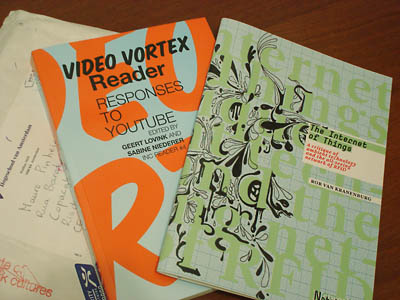
It’s always a joy when new books arrive. These ones arrived from Amsterdam, sent to me by the Institute of Network Cultures. They are The Internet of Things: a critique of ambient technology and the all seeing network of RFID, by Rob van Kranenburg, and Video Vortex Reader: Responses to YouTube, by Geert Lovink and Sabine Niederer (editors).
You can download PDF versions of these books (and many others) on the Institute of Network Cultures’ website.
sexta-feira, 7 de novembro de 2008
Good night lamp
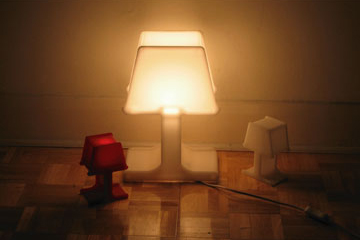
A very simple, but interesting project that promotes a sense of closeness and intimacy. Just turn on your lamp, and someone related to you will have it’s own lamp (a small version of yours) also lighted on.
The Good Night Lamp project is a family of lamps which allow people to communicate the act of coming back home to their loved ones, remotely. As you turn the bigger light on, your presence home is indicated to your friends whose smaller lamps turn on as well. Inversely, the smaller lamps that you’ve collected from your friends will turn on/off as they come home, go out, go to bed. You’ll never come back to an empty home again.
Since we seem to be more and more eager to get a sense of closeness with our loved ones (through instant messengers, twitter and alike), this looks like a very elegant and ‘calm tech’ approach to fulfill this need.
Source: http://www.goodnightlamp.com/
domingo, 26 de outubro de 2008
The end of products, the rise of services
It’s not something new to say that product design is “changing” into service design. But many people still don’t get it quite well. What do you mean? No products?
Yes. No products, at least in some specific situations. As I use to say, you don’t have to own an electric drill. You have to be able to make drill holes, no matter whose eletric drill will you use! You need the service, not the product. For many products we own, we seldon use them – the eletric drill is a classic example!
These changes are specially true when it comes to the digital world. We have seen it happening slowly, for example, with music. We had long play records, cassette tapes. They turned into CDs. And now our CDs are stored in mp3 players.
But we still have to store data in our computers, or, in the case of music, in our mp3 players. But I guess this is just a matter of time to change again. We don’t need to have the files, we need to hear the music. No matter if it is stored in our hard drives, or remotely stored in a server that can be accessed by our players. Storage is a huge problem, we have constantly to buy new storage devices to keep our stuff, as we keep producing and saving files, photos, videos…and it’s worst when you think about the backups! Burning DVDs, or copying files to external hard disks, blue rays or whatever media. I think this will change soon…I already use Dreamhost to store many of my files. I trust them to make the backups, to keep my stuff safe. I guess they have a better backup routine than me (at least, I hope they do!).
I have the feeling that this will not be only about storage. Google already have the Google Docs, with which you can edit many kinds of documents like Microsoft Word files, even if you don’t have Microsoft Word in your computer. One of the topics discussed when Adaptive Path showed their Aurora project was that the limits between the browser and an operational system were not so clear anymore. That makes sense, if you think that we don’t need to have so many programs instaled in our computers. We need to be able to perform the tasks, and that’s the idea behind Google Docs.
I recently was introduced to Lala, a not so original online music service. The new thing about it is that you don’t need to have more than 10 cents to have a “web music” added to your library, which you can stream as many times as you want. If you want to download the mp3 file, you pay more. But you don’t need to…you can just hear it with your iPhone, streaming the file. For 10 cents, not bad. Why would you want mp3 file? To have storage problems tomorrow? Just add the music to your library, and listen to it whenever you want (as long as you have a good connection!), and let them deal with the storage! Soon everything will be connected anyway…pervasive computing is at our doorstep. This way, we prevent for demanding more physical goods, and reduce the electronic waste. It seems more rational and environmental friendly.
A very interesting article about Lala is avalilable at TechCrunch.
Again, it’s not about having the product, but having the service available.
sábado, 25 de outubro de 2008
terça-feira, 21 de outubro de 2008
Presentations available in SlideShare
Busy month. I’ve been to 2 different events (P&D Design and EBAI), presenting some of the research I’ve been doing during my PhD studies.
I have much to tell about both events. But there’s also much things to catch up, to write and to read, and there’s no time to summarize my impressions properly right now.
Anyway, I just wanted to say that I’ve uploaded my presentations to SlideShare. Have fun, if you dare. ;-)
segunda-feira, 13 de outubro de 2008
Nanotechnology and Nokia Morph Concept
It has been a long time now since Nokia presented the Nokia Morph concept video, sharing their vision about how nanotechnology could be used on future communication devices.
I first saw it mentioned in IxDA discussion group. At that time I wrote my impressions about it, and today I got back to it for some reason, and I thought it would be nice to share it with those who eventually read this blog. So, quoting myself:
I was very impressed with the video. Not because of the product itself, but for the possible applications that I could imagine after seeing it. I’m not familiar with nanotechnology, but it seems to me that it is another step towards accomplishing a pervasive/ubiquitous computing world.
It seems to me that nanotechnology would make it possible to really think about embedded computers. Any sort of object could have some kind of “computer” on it. Clothes, glasses, wires…any object could became “smart”.
You may ask: is that something we would want?
I guess we already do! Just look around…
There are some key values that I see in our lives that would be enhanced with this technology.
Information is one key value. We design information systems. We design tools to make easier to find and use information. We produce information. We share information. More than ever, we consume information.
Another key component of our lives is mobility. To be able to access, to communicate, to connect with each other in different spaces is something that is vital to many of us today. Twittering on the way home. Checking emails at the airport. Taking pictures, sending them to our Flickr account in real time etc.
Still we have to deal with many devices that are not so different from our desktops computers. Laptops, iPhones…these are different sizes of a not so different conceptual product. We still have to fous very hard on the object to use it. It still demands our attention. They concentrate hundreds of functions, programs. They are more likely a swiss knife. Many tools in one device.
I guess with nanotechnology we would be able to create products that could rely on a “calm technology” approach, to quote Mark Weiser…As any object can have an “embedded computer”, being able to access information, to exchange data within the environment and within other objects, we start to have dynamic contexts of interaction. Our products could “sense” the environment, and respond to it. Change under the influence of the context. Less effort from us.
Nanotechnology is definitely not only about mobile phones. That is Nokia business, so that’s how they see it.
Nanotechnology is about wearable computers. Hands-free devices. Dynamic environments that change upon your influence.
The interaction benefits I can imagine for nanothecnology are beyond my wildest dreams. :-)